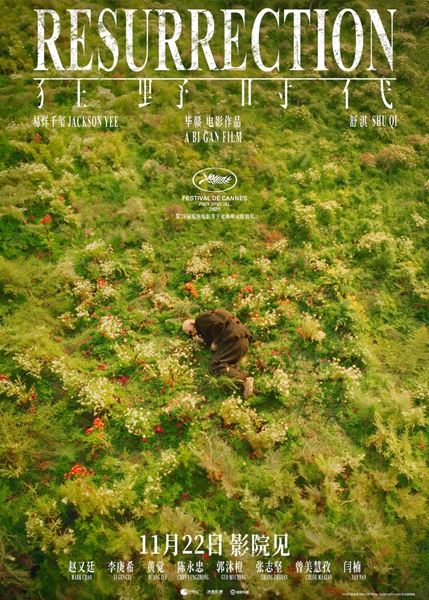
A poster for "Resurrection."
Young actor and movie star Jackson Yee captivated Chinese audiences with his portrayal of five roles in the new film "Resurrection," a surreal and other worldly epic from visionary director Bi Gan, who earned a Special Prize at the 78th Cannes Film Festival for the work this May.
Starring Jackson Yee, Shu Qi, Mark Chao, Li Gengxi and Huang Jue, the other worldly "Resurrection" unfolds through six maze like chapters. They are explored through the varying realms of "seeing," "hearing," "tasting," "smelling," "touching" and within, through "consciousness."
It should be said that even though "Resurrection" is highly complex, it has received critical acclaim and a Cannes award. It also performed strongly at the box office over the last weekend, earning more than 116 million yuan in two days — largely thanks to Yee's star power. However, the film is not for everyone, but instead it can be viewed as a high-end, experimental art-house work.
The film is set in a world where humanity has lost the ability to dream, and a lone creature known as a "Fantasmer" (Jackson Yee) remains entranced by fading illusions. His existence draws the attention of "The Big Other" (Shu Qi), a hunter gifted with the ability to see through layers of illusion, who pursues him through these layered fantasies to wake him and preserve the linear flow of time.
The 160-minute film celebrates Bi's love of cinema, weaving century-spanning fever dreams through sensory and mental dimensions, while tracing Chinese history from the late Qing era to 1999. Yee delivers a versatile, five-role performance. Still, behind its complicated surface, the film hides a surprisingly human story.
In the late Qing chapter,Fantasmer's first form appears as a hunched Nosferatu–Quasimodo-like monster that resides in an opium den. After The Big Other captures him, she — moved by his devotion to his dream life — cracks him open and activates a projector device within his body. This triggers his transformation, causing him to reappear in successive incarnations across different eras and cinematic styles to experience other senses and abstract concepts through wild dreams.
In the 1930s wartime spy story, the youthful Fantasmer named Qiu Moyun exudes a film-noir aura with subtle, enchanting mannerisms as a man accused of murder. In the 1960s segment, he appears as a laicized young monk embodying quiet guilt and introspection while confronting the Spirit of Bitterness in a ruined temple. The narrative then moves to the 1980s, where he becomes a middle-aged con artist balancing cunning with paternal warmth as he trains a fatherless girl to perform fake supernatural smelling acts, capitalizing on the period's intense fascination with paranormal phenomena.
In the director's signature 40-minute long shot, an unruly teen named Apollo on 1999's "doomsday" night captures both the youthful restlessness and regret as he seeks connection, meeting his lover, who as it turns out is a vampire hiding her identity.
At the Beijing premiere on Nov. 21, director Bi said that from the opening shot he aimed to blur the line between cinema and reality, inviting audiences to become part of the film while conveying feelings about vitality, stating, "Human life is extremely complex. By traversing a century through five senses, our goal is to let everyone reconstruct and resurrect their own complex selves."
The film's dreamlike set design and bold scene constructions support this. They weave time, space, fantasy and the actors' performances into a cohesive whole. At the premiere, Yee said, "From the very beginning, we were clear on one thing — we had to distinguish the temperament of each character."
Through distinct physical mannerisms, varied vocal tones for different ages and dynamic interactions with co-stars, Yee said he captured the uniqueness and memorable nature of the five characters. He noted that he often communicated with the director and other creative team members in abstract, whimsical ways and treasured the ample creative freedom.
Describing her creative journey, Shu Qi said, "Every time we pass through a dream, there are different spaces and different performance methods; We have to engage all our senses. It's truly unique."
The film closes in such a manner. With a glowing audience entering a candlelit theater — evoking the feeling of a sacred space — it burns down as the film ends. Viewers melt away like wax, not to signal cinema's demise, but to respond to the "cinema is dead" discourse. Bi uses this ritualistic farewell to affirm devotion to film culture, almost as an answer to those who leave during the film and those that stay. It frames cinema as a dream that endures as long as audiences reconnect with their senses and embrace the art form's immersive power.