The “Silk Road” Music Festival
Between China and India
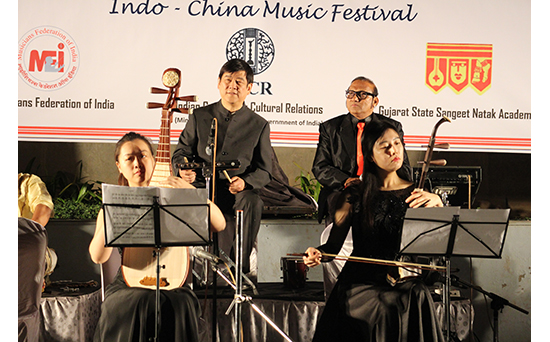
The Opening Concert at Ahmedabad
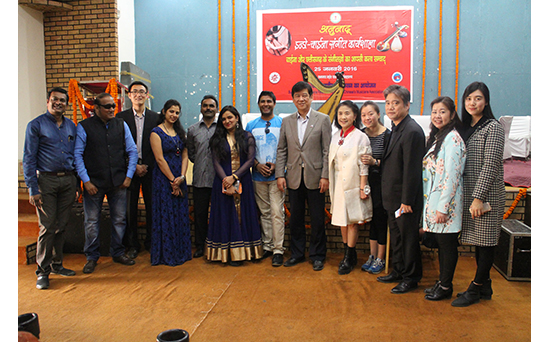
Photo taken at the Raipur Press Conference & Music Workshop
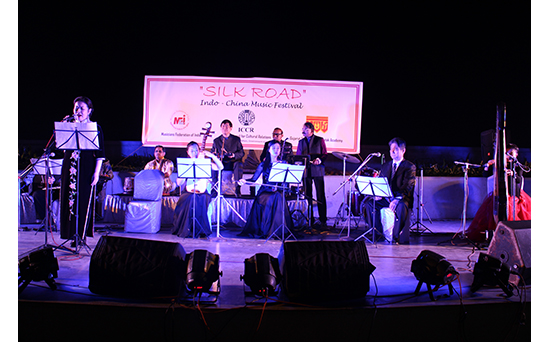
The Opening Concert at Ahmedabad
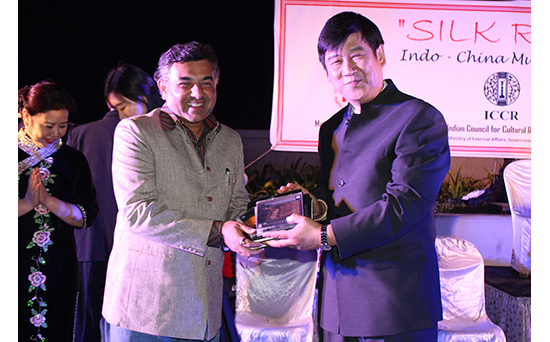
Mr. Makrand Shukla, ICCR Regional Director of Gujarat state, offers a present to Mr. Wang Jianguo
Between China and India
The year of 2015 marked the 65th anniversary of the establishment of diplomatic relations between China and India. At the very beginning of the following year, the “Silk Road” China-India Music Festival opened to renew the bilateral friendship. Under the auspice of CFLAC and the organization of China Musicians Association (CMA), the 8-musician performing group toured with concerts of traditional Chinese music in three cities of India from January 19 till 27, which became a new splendid chapter for China-India friendship.
The festival was jointly sponsored by CFLAC and Indian Council for Cultural Relations (ICCR), undertaken by CMA and Musicians Federation of India (MFI), and supported by Chhattisgarh state government, Nagpur municipal government, Sangeet Natak Academy of Gujarat State and Cultural Centre of South Central Zone. Themed on “Silk Road” for the first time in history, the festival provided the musicians from China and India with a perfect opportunity to showcase each nation’s classic musical works. Mutual understanding and trust between our two peoples have been further strengthened and due contributions have been made to the deep and long friendship between the two countries.
Headed by Mr. Wang Jianguo, CMA’s deputy secretary general, the performing group consists of such celebrated musicians as Ms Cui Junzhi – Konghou musician, professor of Central Conservatory of Music (CCM), and chair of Konghou Professional Committee of China Nationalities Orchestra Society, Mr. Li Zengguang - Dizi musician, state’s First-class performer of China Broadcast Art Troupe, guest professor of the National Academy of Chinese Theater Arts, Ms Liu Haiyan – soprano and associate professor of CCM, Ms Yu Qiushi - Erhu musician of China’s Oriental Performing Group, and Ms Liu Xiaojing - Pipa musician and teacher of CCM.
During their stay in India, the performing group visited Ahmedabad of Gujarat State, Nagpur of Maharashtra State, and Raipur of Chhattisgarh State where they gave three news conferences, three concerts, two workshops on Chinese and Indian music, and participated in cultural exchange events such as “Cultural Evening” in Nagpur. More than 5,000 people attended the festival and enjoyed the performances with enthusiastic applauses. The tour concerts of the festival, well received by the Indian society, fully demonstrated the charms of traditional Chinese music and greatly promoted the musical exchanges and mutual learning between China and India.
Grand Events for Musical Exchange
Three concerts were successively hosted in Ahmedabad, Nagpur and Raipur on the evenings of January 21, 23 and 25. The six Chinese musicians performed such traditional Chinese musical works as Jubilance and Blooming Flowers in the Full Moon for Chinese Instruments Ensemble, The Moon Reflected in the Erquan Spring and Chinese New Year’s Eve for Erhu Solo, Dance of the Yi People and Dragon Boats for Pipa Solo, Beijing, my Hometown and Reed Flowers for Soprano Solo, Herdsman’s New Song, Five Wooden Clappers and Hora Staccato for Dizi Solo, A Flowery Moonlit Night on a Spring River and Facial Masks for Konghou Solo. Two Indian songs of Aajao Tadapte Hain Armaan and Lag Ja Gale Ki Phir Ye Hasin Raat were also rendered by the Chinese Soprano. In collaboration, the Chinese and Indian musicians presented the Jasmine Flower, Horse Race and The Silk-Road Theme Music.
The program for the three tour concerts remained basically the same, yet certain features for each performance could still be discerned. Chinese and Indian national anthems were jointly recorded by the visiting Chinese musicians and their Indian counterparts as well. The opening concert was held at the Riverbank Park of Ahmedabad, the largest city of Gujarat State with a fame of “India’s Economic Miracle” and also the hometown of India’s Prime Minister Narendra Modi. It was also the same place where Chinese President Mr. Xi Jinping met with Indian Prime Minister Narendra Modi during his visit to India. Such arrangement fully demonstrated the importance attached to the tour concerts by the two parties of China and India, and also brought back the fond memories of the meeting between the two national leaders. In the performance in Nagpur, over 2,000 people came and many of them stood to enjoy the show from beginning to end. Numerous people held up their mobile phones to record the entire show. The performance, recorded by local TV stations, would soon be broadcast across the country with an estimate of millions of audiences, which would exert a more extensive and profound impact in the musical circles of China and India.
The three cities of Ahmedabad, Nagpur and Raipur had few artistic exchange programs with China in the past years. For some places, it was the first time for them to receive Chinese musicians and such a communication became a milestone in the historical development of music of the area. The Raipur concert, in particular, witnessed the very first attempt for Chinese konghou and pipa to collaborate respectively with Indian tabla. Chinese konghou virtuoso Cui Junzhi and Indian tabla musician Kumar Pandit performed on Folk Songs Capriccio, and Chinese pipa musician Liu Xiaojing and one of the few Indian female tabla musician Reshma Pandit co-staged Sunflowers. The joint instrumental ensemble was so well received that the whole audience were enchanted by its charms. Chinese Soprano Liu Haiyan rendered two Indian songs of Aajao Tadapte Hain Armaan and Lag Ja Gale Ki Phir Ye Hasin Raat, which enthralled the audiences and brought the performance to the climax. In the meanwhile, the exchange and mutual learning was considerably furthered.
The Cultural Ambassadors
The Chinese music group made a great success in both staging tour concerts and advocating China’s diplomatic positions and cultural heritage. Three press conferences were held in Ahmedabad, Nagpur and Raipur on January 20, 22, and 24, and over 40 local media were present to report on the festival. Mr. Wang Jianguo addressed the media and spoke of the preparations, purpose, programs, and significance of the festival. He stressed that China and India shared a history of cultural exchanges for over 2000 years and that the festival was an important program for the promotion of the friendly relations between the two countries when the communications in music, film and other artistic fields had witnessed more progress. The Chinese musicians also made introductions and demonstrations of the traditional Chinese instruments of konghou, dizi, pipa and erhu, and carried out active interactions with the Indian media.
An incomplete statistics showed that a number of India media reported on the tour concerts with illustrated articles, such as The Times of India, Gujarat News, City Life, Central Chronicle and Proverb Daily. The Times of India published the article titled “Chinese Musicians to Perform Today” and provided a detailed introduction of the three concerts for the festival. In particular, it emphasized the common music cultures shared by two countries and pointed out that the traditional instruments were the best medium for the expression of people’s emotions and feelings and that the unique features also distinguished from their western counterparts. “Chinese Artists Performed at Music Workshop” on Central Chronicle cited the speech of Rakesh Chaturvedi, Director of the Cultural Department of Raipur, “it is a matter of pride for Chhattisgarh that the Chinese artists gave their consent to visit the state at our invitation”. Indigenous folk musicians from Raipur were also invited to perform at the music workshop which provided a perfect opportunity for the musicians of the two countries to know more about the instruments and music of each other so as to have a deeper understanding of the cultural heritage of the two ancient civilizations.
Two serial “China-India Music Workshops” were organized in Nagpur and Raipur on January 22 and 24. The events attracted over 200 musicians and music lovers for attendance. At the workshop, Mr. Wang Jianguo gave rich introductions over the characteristics of Chinese music, made the necessary distinctions from Indian music and western music, and explained the purpose and significance of the tour concerts in India. Chinese musicians respectively introduced the history and features of their instruments, displayed the playing techniques, and helped develop the interests to learn the instruments among the attendees. Soprano Liu Haiyan also gave a brief session for voice training. The Indian people were greatly engaged in the lectures and demonstrations, and were deeply moved, some even with tears, by the charms of Chinese music. It is noteworthy that many Indian young music students and amateurs expressed great enthusiasm for Chinese instrumental music and also uttered strong intentions to learn konghou and other Chinese instruments when proper opportunities showed up later.
Artistic Explorations for “Blend in” Strategy
In recent years, the “Go Global” strategy has speeded up in its implementation to spread Chinese arts and culture abroad. The opportunities and scope for introducing Chinese arts to foreign countries have increased, and the artists become more important in the national diplomacy. It is clearly demonstrated by this festival in India that art is one of the most effective means for the friendly exchanges between different peoples. And the spreading of Chinese art to the rest of the world requires not only the “Go Global” strategy but also the “Blend in” strategy which will enable the excellent artistic achievements of China to enter the daily life of foreign people with a favorable feedback. In this sense, it will thus be possible to narrow down the understanding gap and find a common language so as to realize the heart-to-heart communications between peoples of different cultures and social systems.
Indian cities with little knowledge of traditional Chinese music were purposely selected to hold tour concerts, and public venues of convenient transportations such as parks, squares, campuses, cultural centers were chosen for the performances. The concert program was delicately arranged so as to represent Chinese characteristics while catering to the taste of Indian people. In particular, the performances won overwhelming applauses when Soprano Liu Haiyan started to sing the familiar Indian songs such as Aajao Tadapte Hain Armaan and Lag Ja Gale Ki Phir Ye Hasin Raat. The personal charisma of the artist further increased the charms of the music, thus setting up a friendly and welcome image of Chinese art, and deepened the Indian people’s understanding and recognition of Chinese culture.
During their stay in India, the Chinese music group made full use of the intervals between concerts and rehearsals, and initiated frequent and friendly interactions with the local people, professionals and officials of such institutions as ICCR, MFI, Nagpur municipal government, and Sangeet Natak Academy of Gujarat State. The parties involved conducted deep discussions and reached extensive consensus over the issues of further promoting Chinese music in India, the preservation and inheritance of the traditional music of the two countries, and the development and management of musical organizations. Mr. Kishor Jawade, secretary general of MFI, visited China many times, and he expressed his feelings towards China’s rising and also wished to learn more from China on the development of art. Ratish Tagde, president of MFI, presented the delegation with a gift of India’s “literary and art Bible” which was written over 2000 years ago. He expected the book to be translated into Chinese, and would also like to learn about the origin and development of the time-honored Chinese musical culture. Makrand Shukla, ICCR’s regional director of Gujarat state, also gave an introduction of ICCR and had a discussion on the development of the literary and arts institutions and organizations of China and India. He also observed that India’s Ministry of Culture would officially invite Chinese musicians to perform in India in the near future. Rajeev Shrivastava, director of the Police Department of Chhattisgarh state, asked Ms Cui Junzhi and Ms Liu Xiaojing to give trainings of konghou and pipa in India in future projects. China’s nationally renowned dizi musicians Li Zengguang became friends with Indian flute musician Sunil Verma and talked lengthily over the features of the Chinese and Indian flutes. Coming up with a new approach to the cultural exchange history between China and India, Erhu musician Yu Qiushi proposed the topic how Chinese music could feed its rich development back to the world.
The Chinese music group traveled across three states of India upon a full schedule, with a total traveling distance of over 16,000 kilometers and 11 transitions at airports. All tasks including the transportation of extra-large instruments were fulfilled in a careful and coordinated manner. 60 musical pieces were staged on different occasions. Over 100 cultural officers, musicians, professionals, reporters and local people have experienced face-to-face interactions with the visiting group. Altogether over 5,000 people attended the festival, which was well received by the local governments, the cultural and musical organizations, the Indian musicians as well as Indian public. The music group carried out extensive and friendly exchanges with MFI, forged deep bonds of brotherhood with them, and agreed onto joint efforts for future musical exchanges between our two countries. The tour concerts sowed the seed of Chinese music into the Indian soil, and, with further nourishment from art exchange events, one day it will finally bourgeon and grow into fragrant flowers and bountiful fruits.