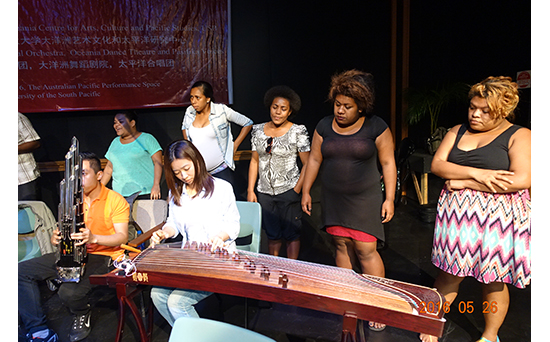
Foreign audience listening to Guzheng performance
Located in the center of Southwest Pacific, Fiji is an archipelago consisting of over 300 islands and its land area only account for 1% of the total territory. With its crucial geographic location, Fiji is a hub of communication in South Pacific region. The climate in Fiji is tropical marine and Fiji is often subjected to cyclone. In March and April this year, Fiji launched national emergency due to the Winston Cyclone. It was a dry winter when we arrived, yet we felt just as comfortable as we were in Beijing. Across the transition between the Eastern and Western Hemispheres, Fiji has the 180° meridian run through it. As the promotion video showed in our flight, a tourist, standing before a tiny landmark, took a step forward into “yesterday” and then a step backward to “today”, which was so interesting.
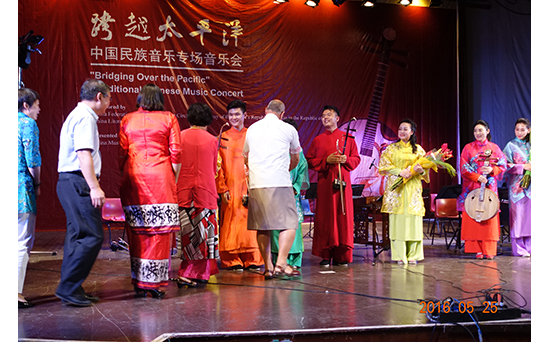
Upon landing, our group was busy with rehearsal and preparations in a careful way. On May 25 at local time, 'Transcending Pacific—Special Chinese National Traditional Music Concert', jointly sponsored by CFLAC and Chinese Embassy in Fiji and undertaken by China National Traditional Orchestra, was staged at City Hall of Suva, capital of Fiji in a perfect way. On that evening, the performance venue—Auditorium of City Hall of Suva, was decorated with lanterns and colored streamers, overflowing with a joyful festive atmosphere. Fiji President Mr. George Konrote and Ms. Konrote, Mr. Zhang Ping, Chinese Ambassador to Fiji, Ms. Rosy Sofia Akbar, Minister for Women, Children and Poverty Alleviation and President of Fiji-China Friendship Association, as well as hundreds of representatives from Chinese enterprises and agencies and Chinese compatriots in Fiji all came to watch the performance and the auditorium was full to its capacity.
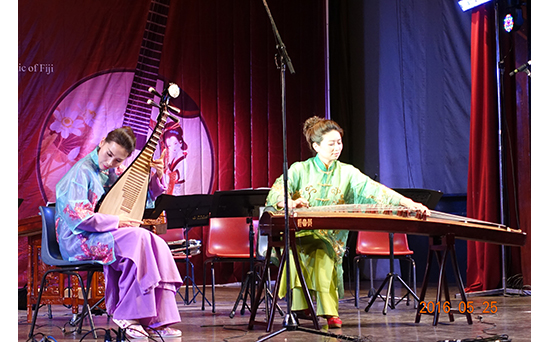
With a string quintet Spring of Tianshan Mountain of Chinese Xinjiang feature, the performance was launched and brought audiences into the sanctuary of oriental music. The duet of Chinese zither and Pipa A Flowery Moonlit Night on a Spring River reflected a charming scenery of the moon and a river on a spring night with its simple yet fine lyric melody, variant rhythm and abundant instrumental skills. Erhu Unison Horses Race presented Mongolian herdsmen’s horse race celebration with dynamic momentum and vigorous melody. Sheng Solo Espana Cani depicted a brave hero of Spanish matador with a time-honored Chinese musical instrument and brought audiences to feel the thrills in the bull-fighting. More than 10 programs of this concert in cadence and excellence received waves upon waves of applauses and cheers from the audiences.
As the reporter of Xinhua News Agency in Suva wrote in his special report, on this special concert titled 'Transcending Pacific', the musicians from China National Traditional Orchestra, by means of unique Chinese musical instruments and traditional way of performance, dedicated an audio-visual feast to the local audiences and introduced a Chinese fashion in such an archipelago in the Pacific as Fiji.
As Wei Yuru, head of group of China National Traditional Orchestra and instrumentalist of Zhong Ruan, responded in an interview in the wake of the concert, CFLAC sent this music group with their exquisite music performance to Fiji in the hope to enable local people to feel the charm of Chinese culture and arts in a close way as well as to better their understanding of and friendship with China. 'Music knows no boundary, and whether we can communicate with local audiences in languages or not, our music can touch their hearts.' Wei concluded.
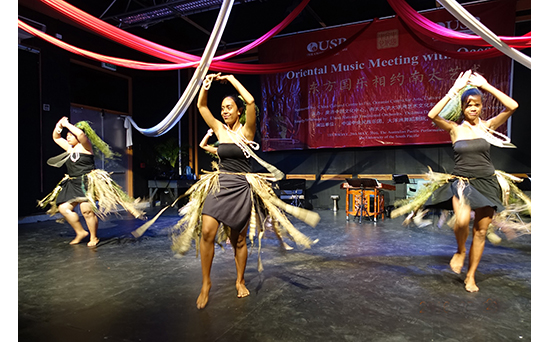
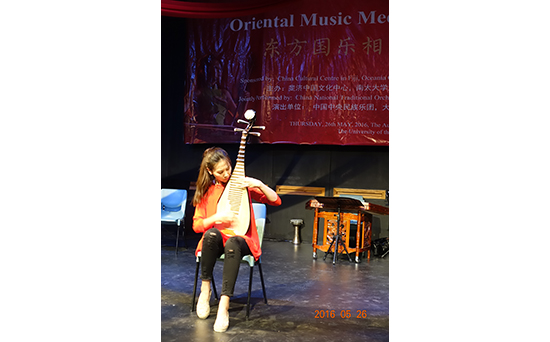
On the evening of May 26, at the beautiful University of South Pacific (USP), along with the melody and singing of Jasmine Flower, an art exchange performance sponsored by Chinese Culture Center in Fiji and jointly participated by Music Group of CFLAC and Oceania Center of USP was underway in a great passion. Prior to the performance, Deng Xianfu, Director General of Chinese Culture Center in Fiji (CCCF) and David Gegeo, Director of Oceania Center of USP delivered speeches respectively. I, as the head of Music Group of CFLAC, responded in gratitude as well. Rajesh Chandra, President of USP, and Ms. Chandra were present to watch the performance.
Under the theme of 'National Melody of Orient Meets with Arts of South Pacific', this exchange performance consisted of graceful and melodious ancient Chinese pieces of music as well as song and dance gala of passionate and exaggerative Fiji features. There were complicated yet sorrowful Chinese Pipa tunes as well as simple and refreshing voices of indigenous group. Such an art combination from both China and Fiji constituted a perfect 'Mix and Match' and brought about high emotions as well as constant interactions with the audiences.
The Music Group of CFLAC presented a tiny ensemble The Silk Road, Chinese Zither Solo Fishing Junks at Sunset, Pipa Solo Dance of the Yi People, and Erhu Unison Horses Race, while Oceania Center of USP performed Hula Dance Jungle, and Chorus Seni Jiale and Tuku Anga. At the end of the performance, both parties joined hands in singing Jasmine Flower and the performance came to the climax. Even after the performance, all the cast of Oceania Center of USP sang the farewell song Isa Isa to bid their reluctant good-bye to the Music Group of CFLAC.
During the stay in Fiji, the group paid a visit to Fiji campus of USP as well. Despite a long distance between China and Fiji and varied ways of living, artists from both countries managed to present performances on the same stage and have a magic exchange in art, which was really an amazing experience. As one of the local audiences said, it was the first time that she had experienced such wonderful audio-visual enjoyment from the Chinese classic music played by traditional Chinese musical instruments. She expected to hear more about national music of China in the future. This exchange performance is CCCF’s first cooperation with a local art agency as well as the local university for the first time. During the special meeting with CCCF, we expressed our hope to take this performance as a good beginning and to bring the resource advantage of CFLAC and the platform of CCCF into full play. Focusing on Fiji as the center and covering of other island countries in the Pacific, CFLAC and CCCF will serve as a bridge for cooperation between Chinese artists and art agencies and all the Pacific island countries to open up a new chapter of cooperation and exchange.
Tonga: Colorful Blossom of Exchange and Friendship
On May 27, we left for the second destination—Tonga. As part of Oceania, the Kingdom of Tonga is located in the west of South Pacific, to the west of the International Date Line and 650 kilometers to the east of Fiji. Located at the main and the biggest island—Tongatapu, the capital Nuku’alofa is the location of the royal family and government as well as the center of industry and commerce, hub of communication and distribution center of imported and exported cargo. Its port can harbor ships with a displacement of tens of thousands of tons. Without industry, the Kingdom of Tonga mainly exports dried coconuts and bananas, and conducts coconut processing and handicraft mat weaving. The numeber of its citizens living all over the world even exceeds that in the Kingdom of Tonga. Thanks to their strong concern about family, the domestic citizens’ life mainly depends on the overseas relative’s remittance. It is easy to find those eye-catching and magnificent graves nearby every household, as it is the very local custom to place their ancestors at the gate of their houses. They will immediately inform their ancestors of any good news such as marriage to share happiness. We can say they are quite an optimistic people.
When we arrived in Tonga, it happened to be the 90th birthday of Her Majesty Queen Mother and various celebrations were held nationwide. On our way to the hotel, we came across several parades of celebration and found festive decoration in the surrounding of Royal Palace. On the evening of May 28, Chinese Traditional Music Concert, jointly sponsored by CFLAC, Chinese Embassy in Tonga and Tonga-China Friendship Association, was successfully staged in Nuku’alofa. Distinguished attendees of this performance included HM Queen Mother Mata’aho, HRH Crown Prince Tupouto’a Ulukalala, HRH Princess Pilolevu Tuita, Lord Tu’ivakano, Speaker of the Legislative Assembly of Tonga, Brigadier General Lord Fielakepa, Chief of Defense Staff of His Majesty’s Armed Forces, the noble family, cabinet ministers, members of the Legislative Assembly as well as Mr. Huang Huaguang, Chinese Ambassador to Tonga, Directors of Tonga-China Friendship Association, Chinese experts for foreign-aid to Tonga, representatives of Chinese enterprises and Chinese Embassy in Tonga.
In the concert, musicians from China National Traditional Orchestra presented an overture with String Quintet Spring of Tianshan Mountain, showcased the musical integration of China and the West by Sheng Solo Espana Cani, and demonstrated unconstrained air of Yellow Plateau with Banhu Solo Qin Vocality. The Chinese Zither and Pipa Duet A Flowery Moonlit Night on a Spring River presented an exceedingly subtle elegance while Erhu Unison Horses Race provided a fascination with galloping momentum. Ultimately, the Ensemble The Silk Road and a folk song of Tonga brought this concert to a perfect conclusion with constant applauses and cheers. In order to express Chinese artists’ heartfelt good wishes towards the 90th birthday of HM Queen Mother, the group improvised an ensemble play of Happy Birthday Song with Chinese musical instruments, which aroused an unprecedented sensation. When I respectfully presented our gifts to HM Queen Mother Mata’aho, this kind yet most honorable lady in the Kingdom of Tonga gave me a hug and a kiss joyously and took a group picture with our whole group to commemorate the moment.
Chinese artists, with their excellent artistry, composed a fine melody of China-Tonga friendship. The success of our performance made Mr. Huang Huaguang, Chinese Ambassador to Tonga, more than excited. In the wake of our performance, the Ambassador and his wife came all the way to offer greetings and gratitude to us. As he commented, the performance satisfied both the royal family and government of Tonga. Our visit would definitely promote further exchanges on literature and arts between the two countries, and facilitate related cooperation in negotiation as well.
Feedback: New Artistic Sense Brought by Nature and Culture
As to the composition of our visiting group to Fiji and Tonga, except for three administrative staff, the other 12 members are artists and instrumentalists from China National Traditional Orchestra. By the all-round contacts within the eight days and nights of this trip, we are no longer strangers. We met each other for the first time and have become close friends and even fraternal brothers and sisters. From the bottom of my heart, I have great respect and admiration for them because it was their devoted performance that brought me to feel about the great charm of Chinese excellent arts and to experience a vivid lesson of Chinese culture’s going abroad.
In our stereotype, diplomats are always mysterious and outstanding as they travel around the world and seem to know everything. As a matter of fact, their imposing attraction is only part of their life in a strange country far from their motherland.They have to overcome various difficulties and endeavor to fulfill diplomatic missions in face of different religions and situations. They are silently yet perseveringly working hard to build a bridge and a bond for effective communications between countries and between various walks of life so as to achieve consensus and cooperation in areas of politics, economy and culture. Furthermore, all the Chinese embassies are a home over foreign soils and a base for solid protection to every overseas Chinese citizen. Though their posting countries vary in size, the embassies all shoulder the same responsibility. Thanks to their detailed and elaborate coordination and liaison, such an excellent exchange platform has been established so that we, in the carrier of arts, can transcend the Pacific Ocean to promote Chinese culture in art exchange and make a contribution to China’s Public Diplomacy.
In the current age, along with the constant progress of technology and the globalization of economic information, exchange and communications are more rapid in a certain sense. Wherever we travel, satellites in the sky, optical cables deep in the sea and various base stations on the ground seem to have connected our life to this world in a closer way. Cooperation between nations and communications between regions are more reflected in the data of trade transaction, road construction and various engineering projects. As we saw in Fiji and Tonga, many Chinese construction teams travel across the ocean to build up apartments and roads in a foreign country what constitutes as their silent contribution to the motherland.
By contrast, cultural exchange is an invisible yet more powerful influence. Though unable to quench the thirsty or feed the hungry, art can touch people’s heart, comfort people’s feelings and formulate people’s spirit. Innumerable facts have proved that the influence of arts goes far beyond anything. Our performance visit is a trip of transcendence as well as a trip of publicity and experience. As I deeply felt, folk arts such as national music and dance are characterized by their easy access to communication and integration across the boundary. We can say that the colorful and multi-element Chinese folk arts are a treasure for lasting exploration. As the largest non·governmental organization of literary and art in China, CFLAC is blessed with advantageous talents and resources of arts, and therefore has an obvious merit and can enhance spacious dimensions in non·governmental cultural exchange. How to bring the influence of art exchange into full play, to promote Chinese culture abroad in a more effective way and to serve the Public Diplomacy is an issue for careful thinking as well as active exploration by every Chinese literary and art worker.
To me, traveling across the Pacific Ocean seems not far. The melodious music that once touched the two island countries of South Pacific still rings in my ears. This art exchange visit tells about our time-honored history and culture, and conveys our cultural pursuit of “World Harmony in Arts”. The magnificent nature gives human impulse for artistic creation. The exchange in thinking and culture ignites artists’ passion. It is said that the famous writer William Somerset Maugham came across the inspiration of his classics The Moon and Sixpence when he traveled across South Pacific. It is also my expectation that this visit will bring my friends of the Orchestra new artistic feelings and new performance experiences.