Kungfu and Panda from China,
Kungfu Panda from America
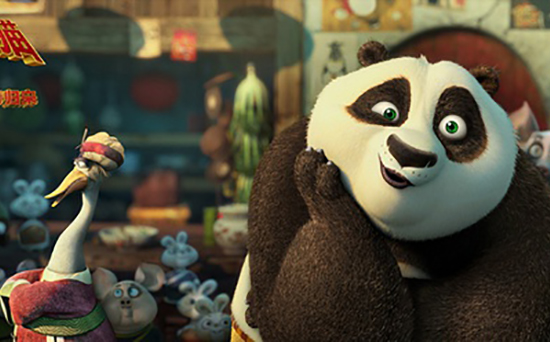
Picture of Kongfu Panda
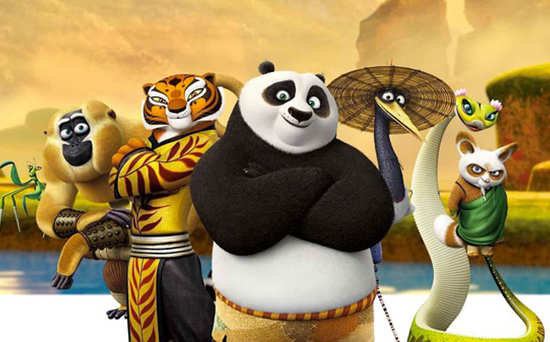
Picture of Kongfu Panda
In the traditional Chinese Spring Festival of 2016, the film Kung Fu Panda 3 witnessed a rapid popularity, thanks to the success of its two previous films as well as its distinct Chinese style. Many merits of this film, such as 3D, animation, plot, legend, myth, philosophy and values, contributed a lot to its positive reviews and considerable box office in China.
There is an interesting saying about films and TV plays in America and China. Americans always favor sequels as they have no idea about history while Chinese often prefer prequels as they can hardly imagine about future. However, Chinese Kungfu and pandas have bridged the history and future, and constituted a 3D blockbuster of American heroism.
Is it a success of American film industry or a success of Chinese traditional culture? Nobody can distinguish one from the other. In other words, both of them are vital factors to the success of this film.
The cool technology of 3D, vivid animation and various cute pandas… all these have made us feel familiar and strange. Comic and animation, not merely catching kids’ attention or attracting their family into cinema, are a media that can arouse sympathy and aesthetic appreciation in hearts of the audiences at all ages. The combination of 3D and animation, as a good carrier of new aesthetic concept and approach, breaks the limitation of tradition and brings audiences to ponder over those serious issues in the context of children’s fun.
However, in China, we still have such a long way to go to achieve a perfect 3D and animation.
The three traditional cultures in China are Confucianism, Buddhism and Taoism. As far as Chinese people are concerned, Confucianism is as ordinary as daily meals and like air, people always neglect its importance though they are within it. Buddhism is like tea whose taste can never be realized until you savor it in your mouth. Only by experiencing hardship in a Buddhist practice can you be enlightened with supreme sagacity that delivers all living creatures from torment. Taoism is a special kind of medicine that helps you to retire from success and self-content to pursue serenity out of doing-nothing or frees you out of frustration or indignation to take natural tendency. In accordance with such a natural Tao, anyone can be capable of everything without doing anything, and become a carefree hermit or swordsman in lofty virtue and noble temperament.
In a word, the powerful ones respect Confucianism, the wisdom lies in Buddhism and the truth comes from Taoism.
Accompanied by leisurely Chinese classical melody, the film presents a scroll of traditional Chinese painting as settings where graceful Kungfu battle took place in constant expressions of ink and brush. Chinese architectures such as the temple with overhanging eave at riverside as well as traditional gloriette, pavilions, halls and attics, plus decoration of artificial rockery and pond, natural flowers, grass and trees, various animal masters of Kungfu such as turtle, crane, golden monkey, viper, tiger and panda and typical Eight Trigrams occurring from time to time demonstrated a strong flavor of Chinese culture.
Po used to be a panda adopted as son by a noodle restaurant owner. As a panda, he was blessed with a round body, everlasting appetite and preference of various food.
As everyone has his or her own dream, Po the Panda, as a cute and fat boy and a fan for Chinese Kungfu, bears a heroic expectation that some day he can become an invincible master to eliminate evil and bring peace to the good as well as strive for a better future together with the Furious Five.
However, the reality is that his family asthma makes Po, a cute and fat panda, feel terrible and resigned every time at the sight of heightened pavilions and towers and even a long ladder.
Just like a fantasy, Po the Pand entered the world of Master Oogway and Kungfu by a mere coincidence.
With the clever guidance of Master Oogway, this cute and fat panda immediately turned into a popular hero and Po’s heroic dream of Kungfu was therefore launched into a wonderful drama.
In Part One, Po, far beyond people’s imagination, became the Dragon Warrior all of sudden. Po assumed that the Dragon Scroll on his handwould enlighten him into the supreme realm of Kungfu, only to find there was nothing but a blank in the scroll. Similarly, Po found out that his foster father’s secret for magic noodle was nothing at all. The interesting relationship between “nothing” and “belief” endows infinitive wisdom to Po and from that moment on he was determined to go naturally with his destiny and accept Master Shifu’s training according to his advantage and disadvantage. In the end, he realized the magic truth of Dragon Scroll and with his pot belly, defeated the rebellious Tai Lung. In Part Two, Po came to realize that he was not the real son of his goose father Ping and during the pursuit of his own real identity and the battles against his opponent Lord Shen, he was enlightened with the magic of inner peace at the village he grew up. At such a young age, Po managed to win over Lord Shen and save his people out of disaster and thus became a true Dragon Warrior. Furthermore, he began to understand the significance of being a real hero, a real self and a real panda.
In Part 3, Po finally met with his own father Li Shan who brought him to feel the strength of family love as well as to understand how to become a real panda. This panda pair of father and son showed adorable innocence and moved audience to tears. At the Panda Village, Po finally came up with the answer to the question of Master Oogway “Who am I?” He is Po the Panda, the Dragon Warrior, son of Panda Li Shan, adopted son of Goose Ping, all of which are correct answers and together constitute a complete profile of a Kungfu Panda. With this truth in mind, Po took his own advantage and brought all his fellows at the Panda Village into full play. In the ultimate duel with Kai, Po’s perfect utilization of Chi, good luck and unyielding spirit led to his victory and the core of Chi Kung proved to be the master’s nills.
Po’s fellows at the Panda Village resurrected him by Chi Kung and he realized the integration of “Panda and Dragon Warrior” by Chi Kung as well.
Full of rise and fall, life will not remain calm until the last part completes. In the radiant Eight Trigrams costume, Po descended from heaven. No longer in confusion or melancholy, he came to understand the true significance of Kungfu—power of innerself. Only by taking his advantage could he achieve his self-evolution, and he is now fully aware of the power of belief as well as the responsibility of a Dragon Warrior. And that was a story of inheritance, for both Kungfu and belief.
Every one of us can be a hero who is invincible in face of adversary. The key point lies in that we need to calm down to think about that question in philosophy “Who am I?” It is only when we know about ourselves, choose to believe in ourselves and take our advantages that we come to understand the significance of our existence and become invincible.
Inheritance relies on every tiny “me” and many tiny “me” will constitute a big “we” who can make it possible for our culture, Kungfu and powerful will to carry on eternal vitality from generation to generation.
We never intend that our offspring can only see pandas in textbooks or specimen or that Kungfu becomes a legend in storytelling and animation. Currently, Kungfu and panda belong to China while the film Kungfu Panda come from America, but one day, I hope, all of them belong to the world.
As we all say, we are striving for a common world.